


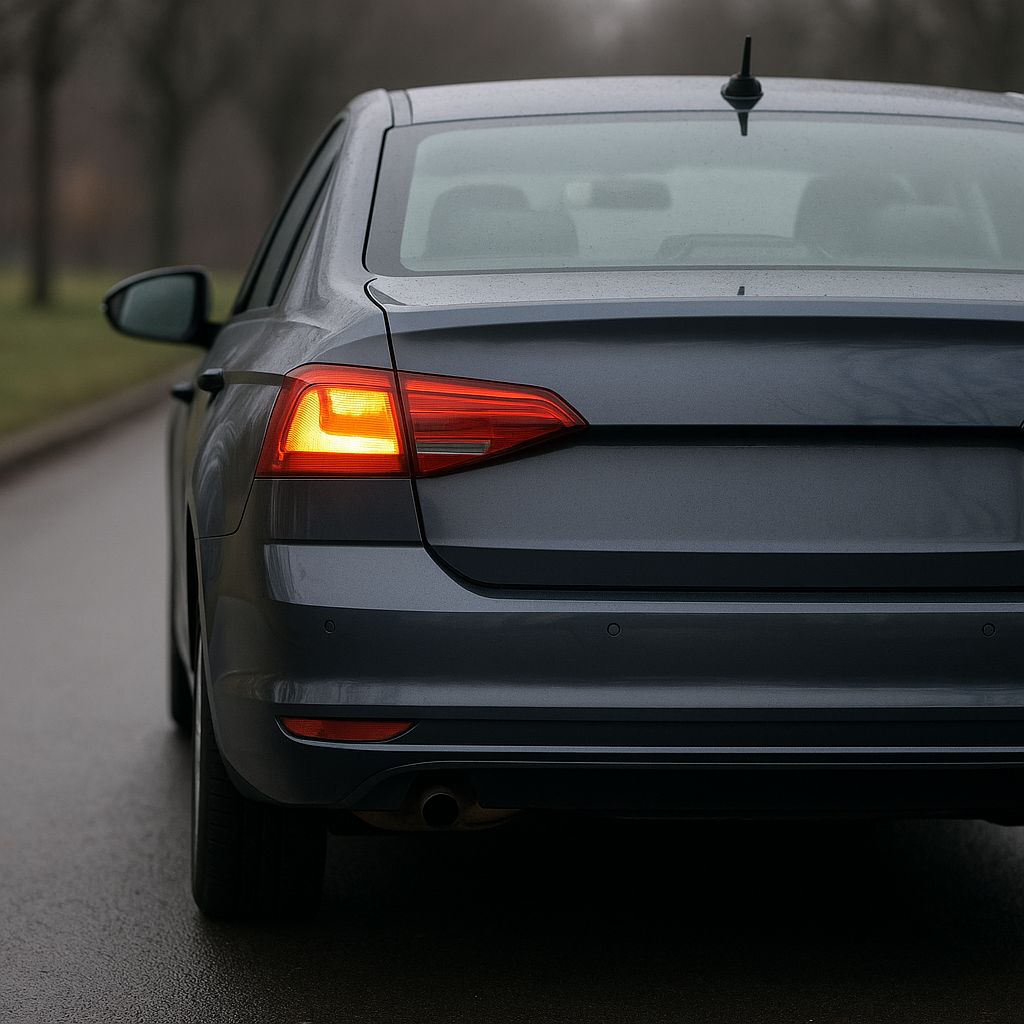
Why Do UK Cars Have Amber Rear Indicators?
Have you ever wondered why, in the UK, the rear turn signals (the lights that flash when you indicate a turn) are amber (that orange-yellow kind of light), not red? It’s one of those little oddities you notice once you think about it. Let’s have a proper chat about it - I promise it’s not as dry as it sounds.
A quick story to kick off
Picture this: you’re driving along the A6 through Stockport, coming up behind a red car. You see it slow a bit, then its right rear light starts flashing. But wait - it’s amber, not red. To you it’s obvious: “They’re turning right.” Now imagine if that flashing were red instead. Could you mix up a turn with braking? Maybe. That’s part of the reason the UK (and much of Europe) insist on amber.
Here at Dace Motor Company, we see all kinds of vehicles in our showrooms in Stockport, Reddish, Eccles. We often get asked about this. It’s a mix of law, safety, and history. Let me walk you through.
It’s the law
This isn’t just some stylistic choice. British (and European) law requires that rear direction indicators must show amber light.
According to the Road Vehicles Lighting Regulations 1989 (as amended) a vehicle mustn’t have any light showing to the rear except red light (for tail lights, brake lights, reflectors) unless it’s an amber indicator or a reversing white light.
In the MOT (annual vehicle test) rules, it states that direction indicators must be amber.
So if you had a rear indicator that flashed red (and wasn’t also exactly a brake light), you’d fail your MOT - unless it’s a very old car made before 1 September 1965. Those older cars are allowed (in some cases) to have red rear indicators (if combined with other lights).
Also, the regulations say no vehicle shall be fitted with a lamp that shows to the rear other than red unless it’s an amber direction indicator (or white reversing, or other permitted light).
So legally, for almost all cars you see on the road in Manchester or Stockport, amber is the only legal colour for rear turn signals.
The safety reasoning
Laws are one thing - but why did they pick amber in the first place? It helps to think about visibility and clarity when driving.
When a light flashes amber, it stands out. It’s distinct from red (which you often see for brake/tail lights) and white (reversing). The brain notices “orange flashing” and can more quickly interpret “that’s a turn”.
If both brake lights and turn signals use red, there’s more room for confusion, especially when a car braking might also be turning. Amber gives an unambiguous signal. Some people claim amber is more visible in poor weather or darkness (though that can depend on the exact bulb/LED design).
Also, different countries tried different rules. In the U.S., for example, rear turn signals can be red or amber. But many car fans in Europe argue amber is safer because you can’t mistake that flashing for a brake.
When you drive around Greater Manchester - on the M60, through Didsbury, past the viaducts - you’re in dense traffic, possibly in rain, fog, dusk, etc. Having signals clearly different from brake lights helps everyone make split-second judgments.
What about imported cars?
Now, this is where things get interesting. Suppose someone imports a car from the U.S. (or from a country where red turn signals are okay).
Because of the lighting regulations and MOT rules, vehicles first used on or after 1 September 1965 must have rear turn signals that flash amber. If not, they’re non-compliant.
There are stories of American cars failing MOT unless their rear lights are converted to amber.
Sometimes people try to “code” or rewire LED lights so the rear flashes amber even if the lens is red. But that can run into legal trouble or MOT failure if not done properly.
Why amber, not some other colour?
Why not green, or blue, or white? Well, that would be confusing or unsafe. The law only allows amber for turn indicators (at the rear) when flashing. The rest of the rear lighting - tail lights, brake lights, reflectors - must be red.
Unless you’re reversing (then white), you can’t legally flash any other colour from the back. The idea is to standardise so every driver knows what each light means. In darkness, rain, or fog, you don’t want to puzzle over what a light is trying to tell you.
If you drove behind a car with, say, green flashing, you'd be scratching your head: turning? signaling? emergency? That’s dangerous. So amber was chosen (and codified) as the safest, most distinct choice.
Local relevance
Because we deal in used cars across Stockport and Manchester, we see many vehicles built for different markets. Some have non-UK lighting setups. One thing we always check (in our 80+ data point HPI checks, in our warranty/purchase prep) is whether the indicators comply with UK regulations.
If a car needs its lighting changed (for rear indicators, front ones, side repeaters) to meet UK MOT standards, that’s something we cover or disclose. We want our customers in Reddish, Eccles, and right across Greater Manchester to drive away without worrying about MOT failures or legal issues.
When you walk through our Greg Street showroom, you’ll see many cars already compliant with amber rear indicators. If something is off, we’ll flag it. That’s part of being trading-standards approved and trustworthy.
Some interesting quirks & FAQs
What about very old cars?
Cars first used before 1 September 1965 may (in some cases) have red rear indicators (especially if they combine with brake lights or other lamps) but they’re special cases.
What if a car has combined brake + indicator in one lamp?
If the same lamp does both, the indicator portion must show amber when flashing (for vehicles after the date cutoff). If it uses red, that’s not legal in many cases.
What about side repeaters or front indicators?
Front ones are white or amber (depending on design), and side repeaters (on many newer cars) are amber. Rear must be amber for turn signals.
Are LEDs different?
LED vs bulb doesn’t change the colour rule. If it flashes red and it’s a turn indicator (rear), it may still fail. The standard is about colour, visibility, and correct function, not the tech.
Do people ever break it and get away with it?
Yes. Some vehicles do pass MOTs when the tester is lenient or misses it. Some cars slip through. But that’s risky - you might later be required to fix it, or get a prohibition notice.
Why do U.S. cars sometimes have red rear turn signals?
Because U.S. regulations allow red in some cases. Many U.S. vehicular standards don’t force amber. So cars built for that market often come that way. When those cars are imported into the UK, their lights often need alteration.
Why you should care (and how Dace can help)
It might seem like a small detail - the colour of your turn signal. But it matters. If your car fails its MOT because of lighting, that’s wasted time, stress, possibly cost. If your signal isn’t distinct, it could contribute to misreading your intention in traffic (especially in Manchester’s rush, wet nights, or on tricky junctions).
At Dace Motor Company, we pride ourselves on transparency and doing things properly (warranty, HPI checks, etc.). When we handle your finance, your inspection, your handover, we make sure things like rear indicators are legal and safe. You don’t want to drive away only to be stopped or fail an MOT a week later.
If you’re thinking of buying a used import, or a car with lighting that doesn’t look quite UK standard - ask us. We can check the setup, advise on whether alterations are needed, even help with the work or sourcing compliant lamps.