


The First Car Ever to Cross an Entire Continent
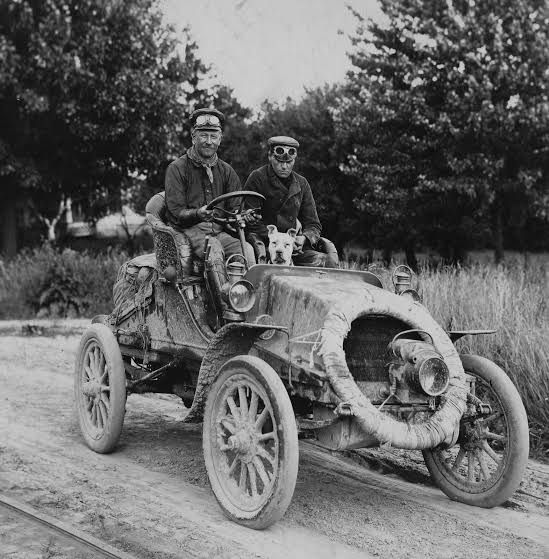
Photo: Horatio Nelson Jackson and Sewall K. Crocker, along with Bud, in the first automobile that made it across the U.S (photo by UVM Special Collections/Bailey-Howe Library, Public domain, via Wikimedia Commons).
When people use a title like “the first car ever to cross an entire continent,” they’re usually talking about the first successful transcontinental car trip across the United States. And even now, that still sounds wild. Today, if you leave Stockport, swing round the M60, head into Manchester, and pull back home with a takeaway coffee cooling in the cup holder, it all feels normal. Cars start. Roads are marked. Fuel is easy to find. If something goes wrong, you ring somebody, open a map on your phone, or pull into a garage. Back in 1903, almost none of that existed for drivers crossing America. The country had rails, horse tracks, rough roads, rivers, mud, dust, and long empty stretches where a car looked like a ridiculous toy. That’s what makes this story stick. It wasn’t just a long drive. It was a giant public test of whether the motor car had a real future at all. At Dace Motor Company, we spend our days around cars from every kind of badge you can think of, and that’s part of why this tale still feels fresh. It reminds you that every easy school run, every quick dash to the Trafford Centre, every late-night run back through Reddish, sits on top of a huge pile of hard-won car history. In 1903, a doctor named Horatio Nelson Jackson, a mechanic named Sewall K. Crocker, and later a bulldog named Bud, took a Winton touring car from San Francisco to New York and proved that a car could cross the country. The Smithsonian calls it the first successful transcontinental automobile trip, and the story still matters because it changed what people thought a car was for. Before that, many people saw cars as rich people’s fun. After that, it got much harder to laugh them off.
A fifty-dollar bet that turned into history
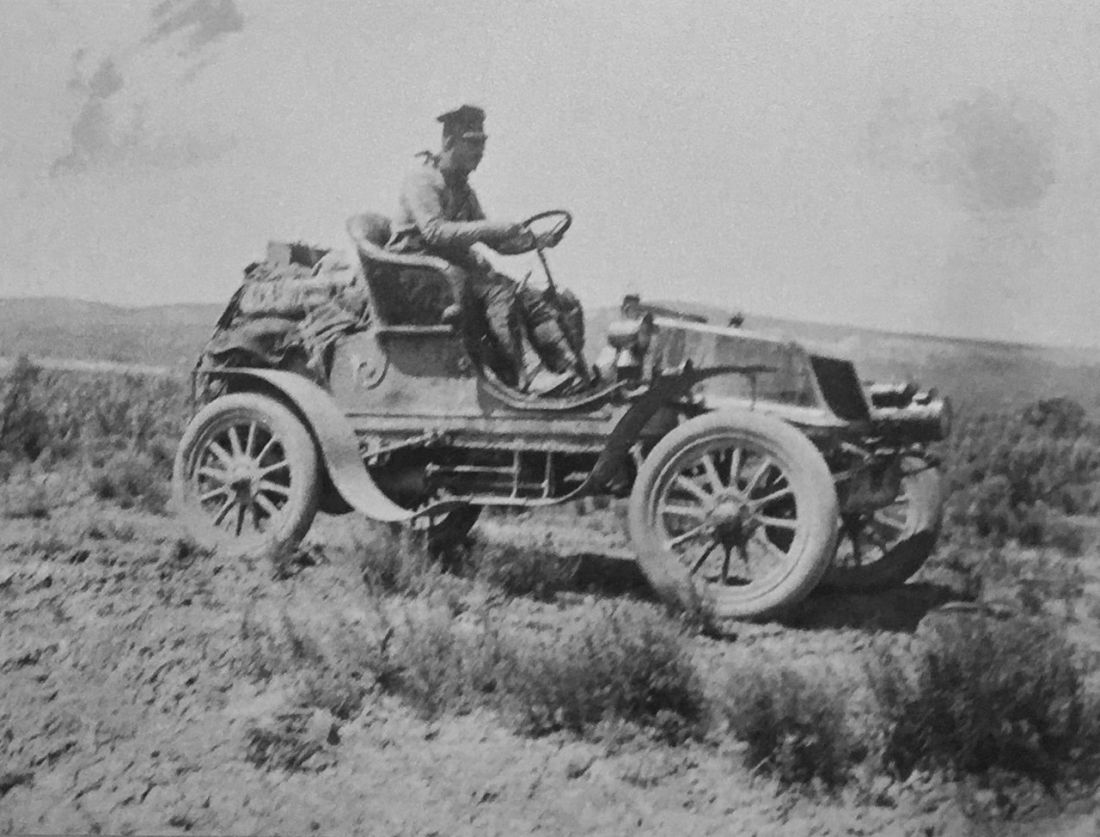
Photo: 1903 Horatio Nelson Jackson in his two-seat Winton tourer, "The Vermont", drives across America (Public domain, via Wikimedia Commons).
The whole thing kicked off in San Francisco after talk at a men’s club about whether a car could get across the country in under 90 days. Jackson, a physician from Burlington, Vermont, decided he’d prove it. That sounds brave. It also sounds a bit bonkers, and to be honest, it was. He bought a slightly used 1903 Winton touring car built by the Winton Motor Carriage Company in Cleveland. The car had a two-cylinder engine and 20 horsepower, which doesn’t sound like much now, but in 1903 it was serious kit. He named the car “Vermont” after his home state and brought in Sewall K. Crocker to ride with him as mechanic, helper, and fellow driver. Crocker mattered just as much as Jackson. A story like this can get told as one bold man taking on the impossible, but that misses the point. Cars in that era broke, shook, slipped, cracked, and coughed their way along. Without someone who could fix things with his hands, the trip would have died early. Jackson and Crocker left San Francisco on May 23, 1903, aiming east. Another reason this bit matters is that they weren’t setting off onto a signed national road. There was no neat blue line across a paper map saying “go this way.” They were making choices as they went, with a car that was loaded with tools, spare bits, supplies, and hope. The Federal Highway Administration says Jackson bought the Winton from a private owner in San Francisco and paid above the list price. PBS ties the whole mad plan to a fifty-dollar bet. Put that together and you get the real mood of the moment: part dare, part stunt, part serious belief that the motor car had something big ahead of it. And once the wheels started turning, there was no easy way back out of it.
Roads that barely deserved the name
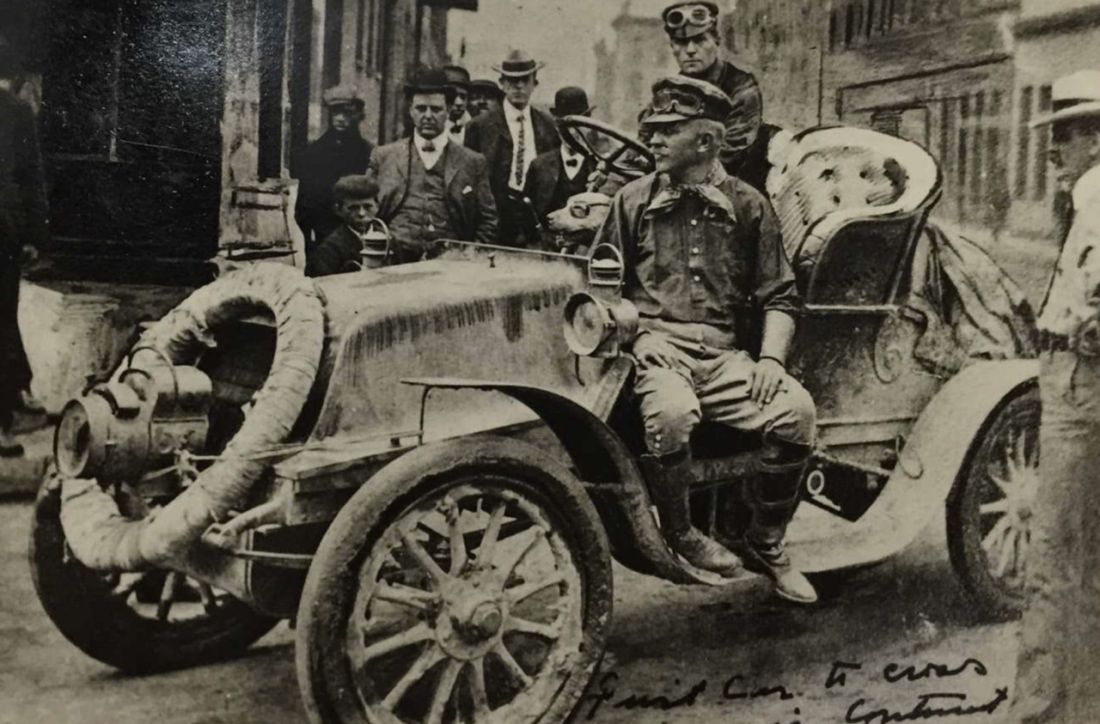
Photo: H. Nelson Jackson on his drive (Public domain, via Wikimedia Commons).
This is the part that makes modern drivers sit up. Jackson and Crocker were not cruising along anything like the roads we know. The Smithsonian says they followed trails, rivers, mountain passes, alkali flats, and the Union Pacific Railroad across the West. Read that again and you get the picture. Trails. Rivers. Railroad lines. That’s not a motoring network. That’s improvising with a steering wheel. They chose a northern line through Oregon, Idaho, and Wyoming, which helped them avoid the Nevada deserts that had beaten Alexander Winton and Charles B. Shanks in an earlier try in 1901. Even with that smarter route, the going was rough enough that they had to deal with mud, washouts, missing bridges, and long gaps between useful places. The Smithsonian also says they used a block and tackle to drag the car out of mudholes and over bad ground, and that when the Winton needed parts, they telegraphed the factory and waited for the railway to bring them. We’ve all been there with car trouble, but this was car trouble turned up to eleven. No breakdown cover. No nearby workshop with the right part on the shelf. No sat nav calmly telling you to take the next left. And the loaded car was heavy too. PBS says that with the men and their gear aboard, it weighed more than a ton and a half, and there were no fuel stations waiting down the road. So when people say this trip was like crossing a continent, they’re not being dramatic for effect. In 1903, the United States was huge in a way that’s hard to feel now. Distance was one problem. Surface was another. Supply was another. And the car itself was still trying to prove it belonged. If you’ve ever hit a pothole around Greater Manchester and muttered under your breath, picture doing that for weeks with dust in your teeth and no clue what sat over the next rise.
Bud, breakdowns, and the human side of the trip
One reason people still love this story is that it isn’t just metal and mileage. Halfway through, it picked up a dog. In Idaho, Jackson got a bulldog named Bud, and Bud ended up becoming part of the legend. The Smithsonian says he joined them in Caldwell, Idaho, and that Jackson even bought him goggles because the dust kept hurting his eyes. That one detail does a lot of work. It takes the tale out of museum-glass mode and makes it feel real. You can suddenly picture the dust, the noise, the bouncing, the heat, the stopping and starting, and this dog sitting there in little driving goggles like the strangest passenger in America. But the sweet bits sit right next to the hard bits. The men were still getting stuck, breaking down, and waiting on parts. The Smithsonian’s record for the car says the full trip took 64 days if you count the delays, and its exhibition page says they finished it in 63 days on the road. That tiny mismatch tells you something useful too: this was not a clean stopwatch run with one neat number and no debate. It was messy, slow, and full of pauses. Case Western Reserve University says the trip cost Jackson about $8,000, which was a huge sum in 1903. So this wasn’t cheap romance. It was expensive grit. And yet people followed it. Newspapers covered it. Rival teams set off trying to beat them. That’s easy to get. We still love watching someone try a thing that sounds impossible on paper. But what makes Jackson, Crocker, and Bud stick in the memory is that they never feel like polished heroes from a perfect story. They feel tired, dusty, stubborn, and human. A bit like anyone who has ever looked at a broken car, sighed, wiped their hands, and had another go because there was nothing else for it. That’s a big part of why the trip still feels close, even after more than a century.
The finish line, the headlines, and the little argument about the timing
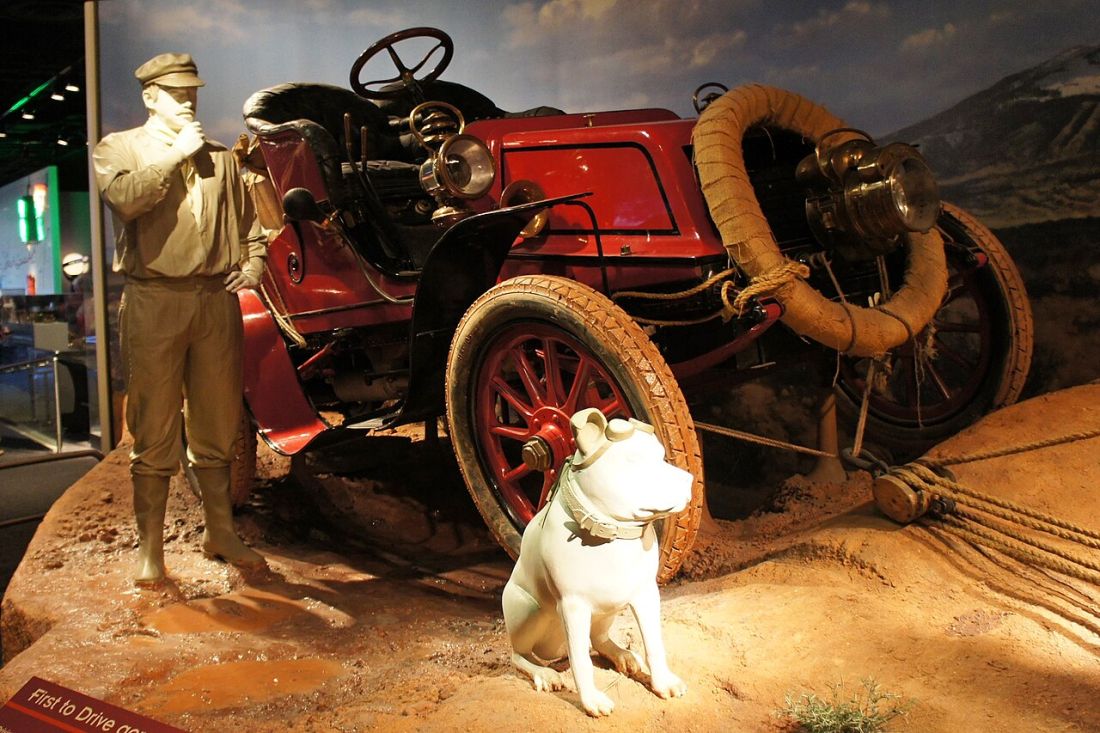
Photo: Exhibit at the National Museum of American History recreating H. Nelson Jackson's first successful North American transcontinental automobile trip in a 1903 Winton touring car, the Vermont (by Mariordo, CC BY-SA 3.0, via Wikimedia Commons).
Jackson and Crocker reached New York City on July 26, 1903. PBS says they arrived at half past four in the morning, and it gives the full elapsed time as 63 days, 12 hours, and 30 minutes. The Census Bureau rounds that to 63 and a half days. The Smithsonian object record says 64 days, while its exhibition page says 63 days. So yes, you’ll see a few versions, and they’re all pointing at the same basic truth: it took a little over nine weeks and it was miles inside the 90-day bet. That’s the sort of small history wrinkle that makes the story feel honest rather than neat. Real life is like that. Numbers get rounded. Newspapers shorten things. Museums explain the same event in slightly different ways depending on what they’re counting. What does not change is the scale of the feat. They had made it from the Pacific side of the country to the Atlantic side in a motor car, and that was enough to make front-page news. The Library of Congress preserves newspapers from the day after the finish, and PBS quotes one report saying Jackson and Crocker had completed the first transcontinental automobile trip. There was even grumbling from skeptics who claimed they must have cheated, maybe by switching cars or putting the Winton on a train for part of the way. Case Western Reserve University says those charges were never proved, and Jackson and the Winton company backed their side hard with cash offers to anyone who could prove the claims. Nobody did. That matters, because public trust was part of the whole point. This trip wasn’t just about two men reaching a city. It was about proving to everybody watching that the car could go the distance. No fuss, no magic, no hidden railway trick. Just a machine, a mechanic, a determined owner, and a very long road that barely counted as a road.
Why this trip changed car history
Here’s the bit people sometimes miss. The trip mattered because it shifted the public mood. Before Jackson and Crocker, a car could still be brushed off as an expensive novelty. After they got to New York, that idea looked shakier. The Smithsonian says their drive helped prove that long-distance road travel was a real possibility, even if it was still hard and expensive. It also says the 1903 run inspired two rival teams of motorists and, within ten years, there were plans for a coast-to-coast highway. That’s a huge change from “cars are toys” to “maybe we should build roads for these things.” And the knock-on effect kept rolling. The Census Bureau points out that six years later, in 1909, Alice Huyler Ramsey became the first woman to drive across the United States, doing it in 59 days. That second fact matters because it shows the first crossing was not some one-off stunt that sat on a shelf. It opened a door. Other people walked through it. Then more did. Then a lot more. By the late 1910s and early 1920s, the Smithsonian says autocampers with touring cars and tents were already turning transcontinental motoring into a real way to see the country. In other words, the road trip that feels baked into modern life had to start somewhere, and this is one of the clearest starting points. There’s also a lovely physical reminder that it all happened. Jackson later gave the Winton, still called the Vermont, to the Smithsonian, where it survives as a museum object. So the car is still here. You can stand in front of it and remember that a thing we now treat as ordinary was once so uncertain that proving it could cross a country felt like headline news. That’s a proper shift in how people saw freedom, distance, and the point of owning a car in the first place.
What this old Winton still says to drivers in Stockport and Manchester
There’s a reason Dace Motor Company likes stories like this one, even though the cars on our forecourts are a long, long way from a 1903 Winton. The first successful drive across the United States reminds you that every used car on sale today comes from a line of machines that had to earn people’s trust one mile at a time. Jackson and Crocker did not cross America in comfort. They crossed it in argument with the road, with the weather, with broken parts, and with a crowd of doubters waiting to say, “Told you so.” But they got there. And because they got there, the idea of what a car could be grew fast. That matters in Greater Manchester too, because car life here is built on something simple. People need to get places. School, work, football, family visits, the big shop, a run out at the weekend, a dash across town before the rain starts again. Whether you’re crawling past Stockport town centre, heading out across the A6, or trying to time a smooth run before traffic thickens up near Manchester, you expect your car to be a real part of life, not a fragile experiment. That expectation had to start somewhere. This story is one of those starting points. And maybe that’s why it still lands. It’s got speed, mud, risk, a dog in goggles, a bet, and a finish line in New York before breakfast. But under all that, it’s really about belief. Somebody looked at a machine that most people doubted and said, “I think this can do far more than people think.” Then he found the right mechanic, turned the key, and proved it. Over a century later, that still feels good to read about. You know, some stories stay alive because they tell us where the everyday stuff around us first got its nerve. This is one of them.