


How Le Mans Racing Influenced Everyday Cars
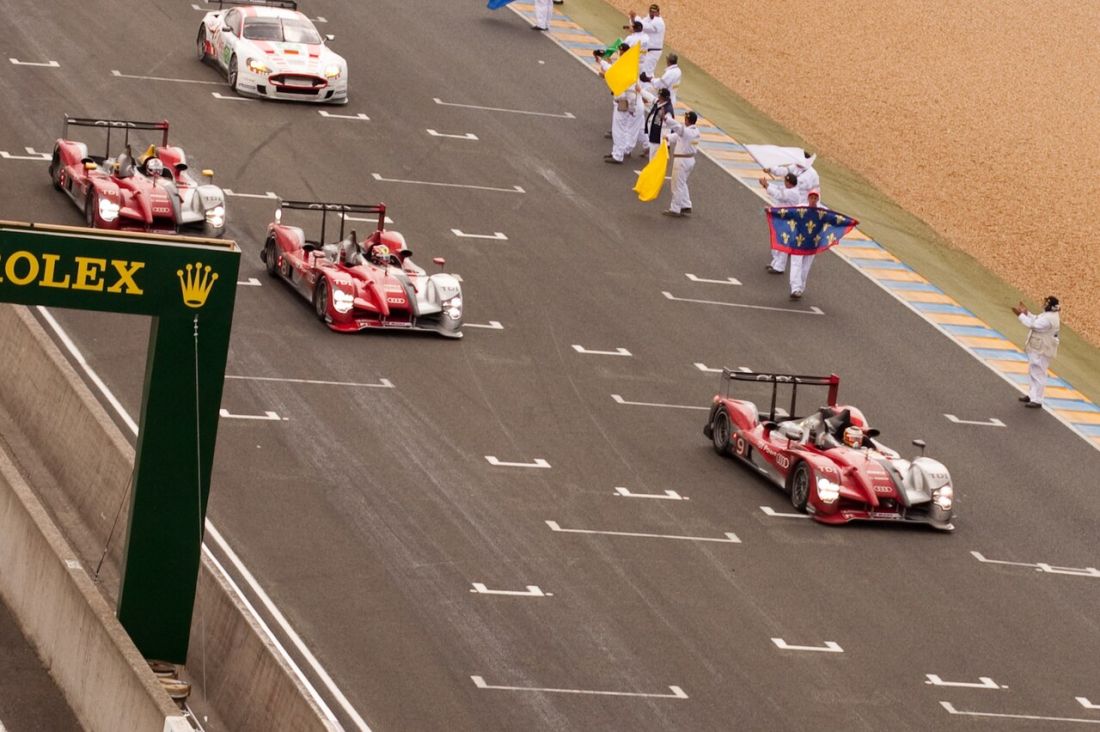
Photos: Marshals waving safety flags to congratulate Audi in 2010 Le Mans race by Arnaud333, CC BY-SA 3.0, via Wikimedia Commons.
At Dace Motor Company, we spend our days around cars that have to do real jobs. School runs. Commutes through Stockport traffic. Wet trips round the M60. Late dashes across Manchester when the sat nav says twenty minutes and you know full well it means thirty. So it’s fair to ask why a race in France matters to any of that. The answer is simple: the 24 Hours of Le Mans has been a giant stress test for car ideas since the very start. The first race was held on 26 and 27 May 1923, and it was created to push technical progress and help the motor trade grow. The track mixes permanent circuit sections with public roads, which means cars have always been tested in a way that feels closer to real driving than most forms of racing do. Add darkness, fog, rain, huge straight-line speed and a full day of punishment, and weak ideas get found out fast. Good ideas survive. Then, after a few years of hard lessons, those ideas start showing up in cars that regular people can buy. That’s why Le Mans has such a long list of firsts and near-firsts, from early work on body shape and front-wheel drive to later leaps in tyres, safer glass, hybrids and lighting. You can trace a line from that race to things drivers now barely think about, which is funny when you stop and think about it. Your car starts in the morning, stops in the wet, lights up dark roads properly, uses less fuel than older cars did, and asks less from its tyres. None of that happened by luck. A lot of it came from engineers being pushed to the limit at Le Mans, then taking what worked and bringing it back to normal roads.
The day brakes stopped fading and started saving people
If there’s one Le Mans lesson that changed daily driving in the biggest, most obvious way, it’s braking. Early race cars used drum brakes, and drum brakes could lose their bite when they got hot. That was bad enough on a short blast. Over 24 hours at race speed, it was a real problem. Jaguar saw that issue clearly after winning Le Mans in 1951. The company worked with Dunlop through the winter of 1951 and 1952 to build disc brakes that could keep working hard without giving up when the heat piled on. Stirling Moss then won at Reims in 1952 in a Jaguar fitted with disc brakes, the first time an international motor race had been won by a car using them. A year later, Jaguar’s C-Type arrived at Le Mans in 1953 with that new braking system properly sorted. Tony Rolt and Duncan Hamilton won, the team finished first, second and fourth, and the car became the first disc-brake winner of the race. It also broke the 4,000-kilometre barrier and beat the earlier distance by a huge margin, even though the engine had gained only a modest bump in output. That tells you a lot. Better stopping changed the whole picture. The car could brake later, brake harder, and keep doing it deep into the race. For normal drivers, that same basic idea became one of the biggest safety leaps a car ever had. When you hit the brakes on a rainy road near Portwood roundabout or slow from motorway speed after a run past the airport, you want the car to feel calm and steady, not vague and tired. That confidence is part of the everyday gift from Le Mans. Disc brakes moved from race innovation to regular road-car hardware because they proved, under the harshest possible conditions, that they were simply better at the job.
Pulling from the front and seeing through safer glass
Le Mans didn’t just help cars stop better. It also nudged car makers toward layouts and safety pieces that became normal later on. One of the clever early examples came in 1927, when Jean-Albert Grégoire’s Tracta brought front-wheel drive to the race and finished seventh. That sounds like a small history note, but it matters because front-wheel drive ended up becoming the default choice for loads of everyday cars. There’s a good reason for that. It can save space, free up room inside the cabin, and give a tidy, predictable feel in poor weather. For people driving around Manchester and Stockport, where greasy roads and steady drizzle are pretty much part of the scenery, that matters more than lap times ever will. You feel it when a hatchback pulls neatly out of a junction instead of getting flustered. You feel it when the car stays settled on a damp roundabout. Le Mans helped prove that different layouts were worth trying, even when the safe bet would have been sticking with what everyone already knew. The same thing happened with glass. In 1961, Saint-Gobain Italia fitted triplex windscreen parts to the Ferrari 150 TRI. This glass used three layers with plastic sheets in between, and the point was simple: if gravel hit the outer layer, the whole thing was less likely to shatter into danger. The design became standard in windscreens in the following years. That’s huge. It means one of the parts you barely notice on your own car is there in its safer form because racing forced engineers to think hard about what happens at speed when something goes wrong. So the next time you look through a modern windscreen or drive a front-wheel-drive family car, you’re seeing two Le Mans lessons hiding in plain sight. Quiet changes. Massive effect.
Slippery shapes and cleaner air
A lot of people hear the word “aerodynamics” and think it belongs in a race engineer’s notebook, somewhere far away from normal life. But body shape matters every single time a car moves. It affects fuel use, wind noise, high-speed stability and even how calm a car feels when a lorry thunders past on the motorway. Le Mans pushed that lesson early. Back in 1925, the Chenard & Walcker Tank helped lay the foundations for proper aerodynamic thinking. Then came strange-looking machines like the rebodied Cadillac nicknamed “Le Monstre” in 1950, followed later by cars such as the short-tail Porsche 917K, which set a distance record in 1971 by covering 5,335.31 kilometres. These cars looked the way they looked because air is stubborn. If a car punches a messy hole through it, the engine has to work harder and the body feels less planted. If the shape is smoother, the car wastes less effort. That idea has filtered right down to ordinary road cars. The rounded noses, cleaner side mirrors, carefully shaped bumpers and flatter undersides you see today are not there just for show. They help cars move through the air with less fuss. Even modern endurance cars kept teaching the same lesson. Toyota said the placement of the front motor-generator in its TS050 Hybrid helped improve under-floor airflow, while new aerodynamic thinking shaped huge parts of the car. That kind of packaging work sounds nerdy, but the result on road cars is easy to grasp. You get better efficiency. You get less wind roar on a run down the East Lancs. You get a car that feels less twitchy in a crosswind on the way past the Etihad or out toward the Peaks. Good aero is not about making a family car look like a spaceship. It’s about making it easier, calmer and cheaper to live with. Le Mans taught that lesson again and again.
Lighter cars feel better because racers hated wasted weight
If you ask most drivers what makes a car feel good, they might say quick steering, a comfy seat, or an engine with a bit of shove. Fair enough. But hidden underneath all that is weight. Or, better put, the fight against extra weight. Le Mans has always been obsessed with that fight because a lighter car asks less from everything. Less from the brakes. Less from the tyres. Less from the engine. Less from the fuel tank. That thinking kept getting sharper, and by the 1990s carbon fibre shells had arrived at Le Mans in a serious way. The official race history points to 1995 as a key moment, when McLaren brought carbon-fibre shell know-how to Le Mans and the F1 GTR won on its first try in the hands of Yannick Dalmas, Masanori Sekiya and JJ Lehto. McLaren also says the road-going F1 was the first road car built around a lightweight carbon fibre centre structure, which tells you this was never just a race-only trick. The appeal was clear: very high strength, impressive stiffness and low mass compared with older materials. Now, your average family car in Stockport is not made like a rare supercar, and that’s fine. But the lesson still moved across. Carmakers learned to mix materials better, trim grams wherever they could, and chase stiffness without making cars feel like tanks. Audi even described its R18 programme as being in line with a push for lighter and more efficient production cars. You can feel the benefit in everyday ways. A lighter car changes direction more sweetly. It rides and stops with less effort. It can sip less fuel. It can carry all the safety kit and comfort kit people want without turning into a lump. That’s the Le Mans pattern all over again: race teams hunt a gain for survival and speed, then road cars pick up the same idea in a form that works on ordinary streets.
Night racing changed the way we see at night
Le Mans runs through the night, and that makes lighting a serious issue, not a styling exercise. Drivers are tired, speeds are high, and a badly lit stretch can ruin your whole race in a split second. That pressure helped push headlight tech forward in a big way. Audi is the clearest modern example. The company said the Audi R8 road car was the first one credited with full diode-based headlights worldwide, and that the race-going R18 in 2011 became the first Le Mans sports car to use them across the whole headlight setup. Audi’s engineers liked the system because the light was strong, reliable and steady, which mattered hugely at night. Then the road-car side kept catching up. Audi later said the matrix-style version of that lighting moved from the R18 into production cars, and that laser-assisted lighting tested at Le Mans also made its way into road models. That’s a straight line from race track to driveway. And there’s another neat detail that says a lot about how modern car design works. Audi said its digital rear-view mirror system improved visibility for drivers at Le Mans and now helps reduce the frontal area of production cars, which can help increase range, especially for electric cars. In other words, even the way a car sees behind itself can help it cut through the air better. You don’t need to be a car nut to appreciate any of this. You just need to have driven down an unlit road on a winter evening and felt the relief of a headlight setup that actually lets you read the road properly. Better spread, less strain, clearer edges, fewer nasty surprises. That matters on a dark lane, on a ring road, or on a late trip home after football. Le Mans turned night driving into a laboratory, and road cars got the reward.
Using less fuel while still feeling lively
This is where Le Mans gets really clever, because the race is not just about being quick. It’s about being quick for a full day without wasting energy. That changes the kind of engineering that gets rewarded. Audi’s run is a good example. Audi says its direct petrol injection system was first used at Le Mans in 2001 on the R8 race car, where it improved fuel use and throttle response. The company also said customers could order production models with that system shortly after the first Le Mans success, and that the method soon spread through large-volume production. Then came the diesel era. In 2006, Audi won Le Mans with the R10, the first diesel-powered race car to do it, and the firm said the lessons kept feeding into the design of parts such as pistons and fuel injectors for road cars. Toyota took the next big step by pushing hybrid ideas hard. Its history pages say the company returned to top-class Le Mans racing in 2012 with the TS030 Hybrid, pouring road-car hybrid knowledge into a race system built for extreme use. Later, Toyota said the TS040 acted like a rolling test bench that contributed to current road cars, while the TS050 used front and rear motor-generators to recover braking energy in the same basic way as Toyota road cars. The company also said the race programme delivered a 35 per cent improvement in fuel use since 2012, and that the technology and know-how were helping road-car development and mass-produced hybrid and electric vehicles. Shigeki Tomoyama even said Le Mans helped Toyota advance hybrid tech and transfer what it learned into production cars. So when a modern road car gives you better mileage, sharper response and a clever system that saves energy under braking, that is not some random miracle cooked up in a quiet office. A lot of it was hammered into shape in endurance racing, where waste gets punished and smart ideas get rewarded.
Why this still matters on a wet Tuesday in Stockport
The funny thing about Le Mans is that its influence can seem dramatic and ordinary at the same time. Dramatic because the race has always been full of big names, weird-looking machines and brave drivers like Duncan Hamilton, Tony Rolt, Tom Kristensen, Allan McNish, Marcel Fässler, André Lotterer and Benoît Tréluyer. Ordinary because the wins that changed road cars were really about very normal things: a brake that keeps working, a windscreen that breaks in a safer way, a tyre that grips without wearing itself out too quickly, or a body shape that wastes less fuel on the motorway. Tyres are a perfect example. The official Le Mans history makes clear that they have been central to the race since 1923, and over time the sport pushed wider tyre sizes, lower sidewalls, slick dry-weather tyres, proper wet-weather choices and smarter balancing of grip and endurance. Michelin’s race history also says its radial tyre offered long-lasting safety, comfort and fuel economy, then proved its worth at Le Mans and later became the industry norm. Even the newest endurance tyre projects are still chasing the same basic targets: better life, strong performance and lower resource use. So yes, the race cars are wild. But the lessons are grounded. They show up in the used cars people buy for work, family, shopping and weekends away. That’s why this bit of history matters to us at Dace Motor Company and, really, to anyone looking for a car that feels sorted. Whether you’re looking at an Audi, Toyota, Jaguar, Ford, BMW or something small and sensible for getting across town, you’re looking at decades of ideas that survived one of the hardest tests in motoring. From the bright lights of Deansgate to a rainy crawl near the Trafford Centre, Le Mans is still there, hiding in the parts that make everyday cars feel safer, sharper and easier to trust.