


How Ford’s Assembly Line Changed the World Forever
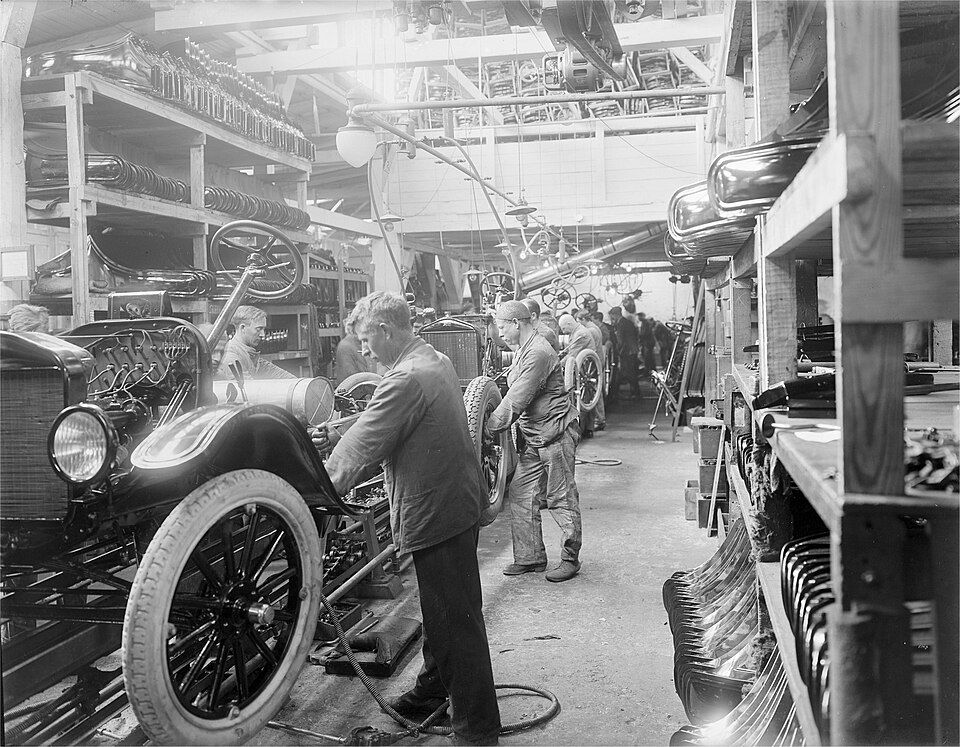
Photo: Ford assembly line at Ford's factory in Heimdalsgade in 1923 (by Peter Elfelt, CC BY-SA 4.0, via Wikimedia Commons)
Back in the early 1900s, getting a car wasn’t like popping down to Stockport on a Saturday and having a wander round rows of motors. It was closer to buying something hand-built, like a fancy bit of furniture. A small team would build a car in one spot, doing loads of different jobs from start to finish. That meant cars took ages to make, which pushed prices up, which meant regular families couldn’t just go “yeah, we’ll have one of those.” Henry Ford didn’t invent the car, and he didn’t invent the idea of breaking work into steps either. What he did was take a big, complicated product (a whole car) and figure out how to make it in a smoother, repeatable way so the price could drop and the number of cars could rise. That’s the bit that flipped everything. When we talk to people at Dace Motor Company who are choosing a used car, you can still feel the knock-on effect of that change. You’ve got choice. You can compare different makes. You can expect parts to exist, garages to know what they’re doing, and roads to be full of cars that normal people can afford. None of that was guaranteed back then. And here’s the wild part: the assembly line didn’t just change cars. It changed how people worked, how cities grew, how shopping worked, how food got packed, how gadgets got made, and even what “a fair day’s pay” looked like. It sounds dramatic, but once you see how it worked, you get why it spread so fast.
So what did Ford actually change?
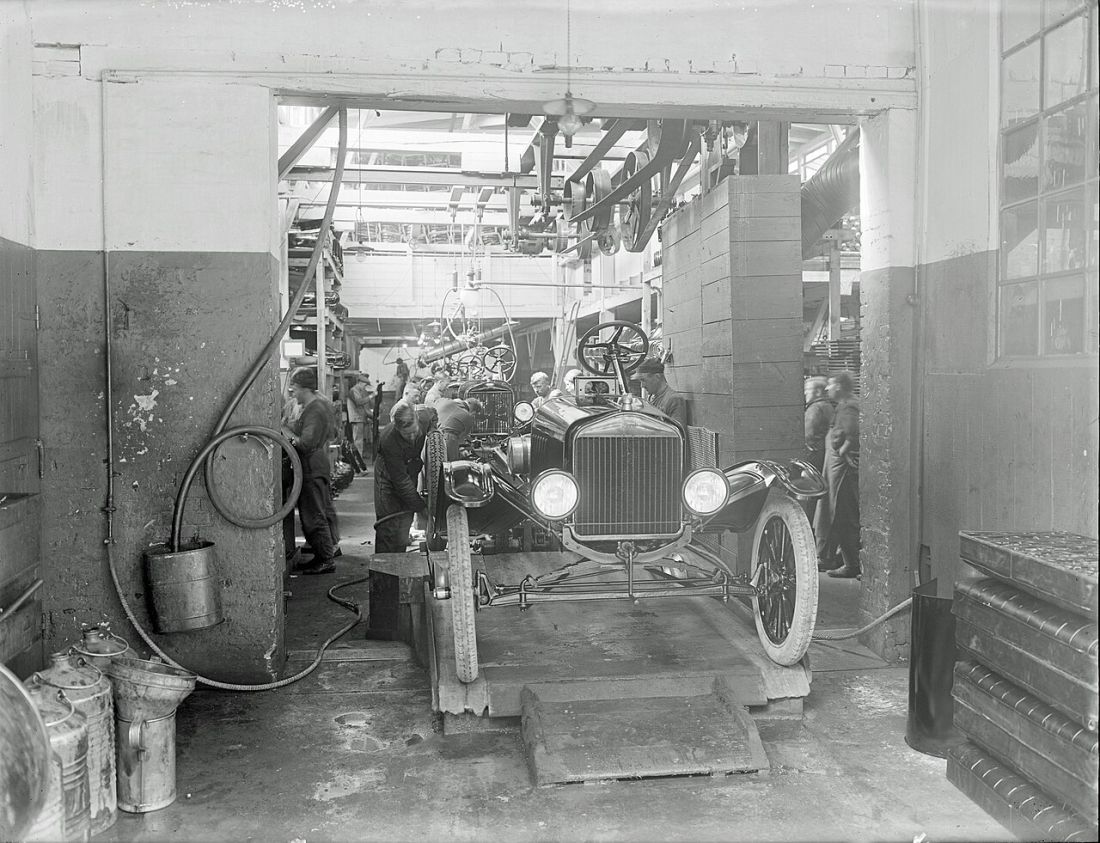
Photo: Assembly line Ford T, 1923 by Peter Elfelt, CC BY-SA 4.0, via Wikimedia Commons
The basic idea is simple: instead of workers walking around a car, the car moved past the workers. Each person did one job again and again, using parts that were already made to match. Ford’s big moment with the moving assembly line happened at the Highland Park plant near Detroit in 1913. Before that, Ford was already pushing the Model T hard, trying to build loads of them, but the moving line made production jump in a way people couldn’t ignore. According to the Detroit Historical Society’s write-up on the Model T, the chassis assembly time dropped from about 12 hours to 93 minutes by 1914. Let that sink in. From basically “all day” to “about the length of a football match and a bit.” That kind of speed didn’t just mean more cars. It meant a different price, a different business plan, a different kind of job, a different idea of what a factory could be. And to be honest, it made other companies feel a bit panicky.
If Ford could do that, everyone else had to catch up or get left behind. People around Ford mattered here too. Charles E. Sorensen, a major production leader at Ford (nicknamed “Cast-Iron Charlie”), gets linked to developing assembly line methods inside Ford, alongside other managers and engineers. So it wasn’t just one bloke in a room having a genius thought. It was a messy, real workplace problem getting solved by people testing stuff, arguing, tweaking, then trying again. You know how it is when you’re trying to get anything running smoothly, whether it’s a service desk, a kitchen, or a showroom. Someone spots a bottleneck, someone else fixes it, then another problem pops up. That’s what early mass production looked like, just on a huge scale.
Wait… didn’t someone else do assembly lines before Ford?
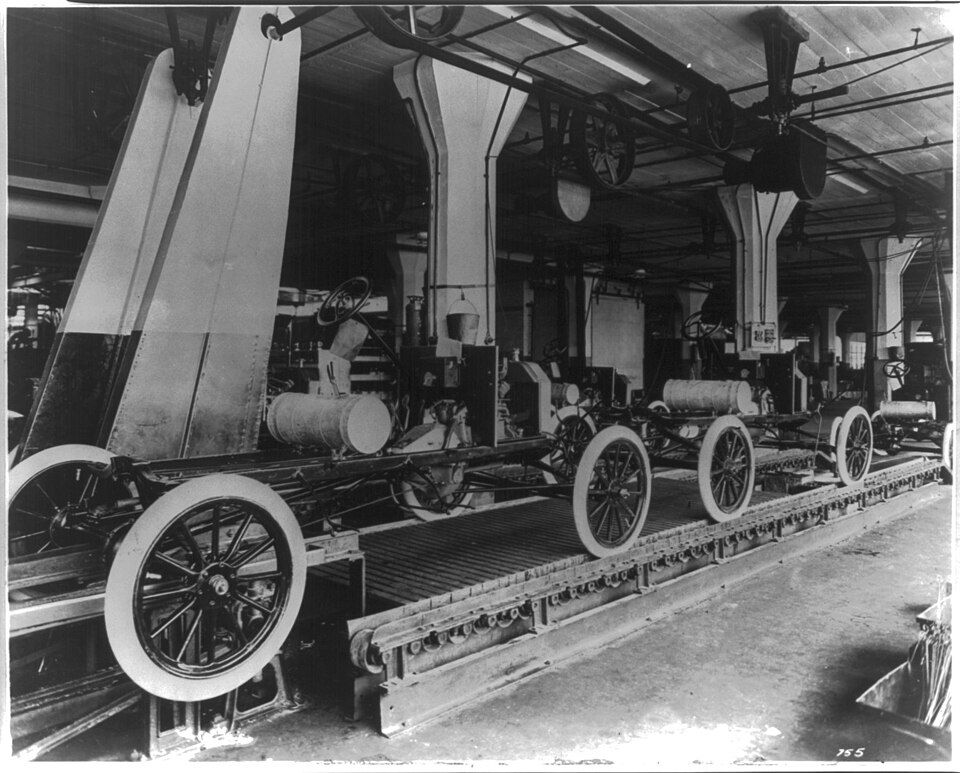
Photo: Assembly line at the Ford Motor Company's Highland Park plant by Miscellaneous Items in High Demand, PPOC, Library of Congress, Public domain, via Wikimedia Commons.
Yeah, and this bit gets missed because Ford’s name is the one everyone remembers. Before Ford’s moving line, other companies were already using assembly line ideas in different forms. Ransom E. Olds, from Oldsmobile, gets credited with using assembly line methods for the Curved Dash Oldsmobile in the early 1900s. That car is even described as one of the first mass-produced automobiles, made using interchangeable parts. So if you’re thinking, “Hold on, this wasn’t brand new,” you’re right. The difference is that Ford pushed the moving assembly line further and applied it to building a whole car at massive scale. It’s a bit like football tactics. Plenty of teams try a system, but one team makes it work so well that everyone starts copying it.
Ford didn’t just have an assembly line. Ford had an assembly line that turned out cars fast enough, and cheap enough, that the whole market shifted. And once prices started dropping, demand grew, then production grew again, then prices dropped again. That loop is a big reason cars stopped being a toy for the rich and turned into something families could plan for. There’s also a “human” side to why Ford’s version grabbed headlines. A moving line is loud, physical proof that something new is happening. You can watch the chassis rolling past. You can count cars. You can feel the pace. It wasn’t just a business trick hidden in an office. It was right there on the factory floor, in motion. And once it’s in motion, you start changing everything around it: where parts are stored, how tools are placed, how jobs are timed, how breaks are handled. It’s not glamorous, but it’s powerful. If you’ve ever seen the M60 crawling at rush hour and thought, “How have we built a whole city around this many cars?”-that’s part of the chain reaction that started with factories learning to produce cars in huge numbers.
How it reshaped jobs and pay (and why that mattered)
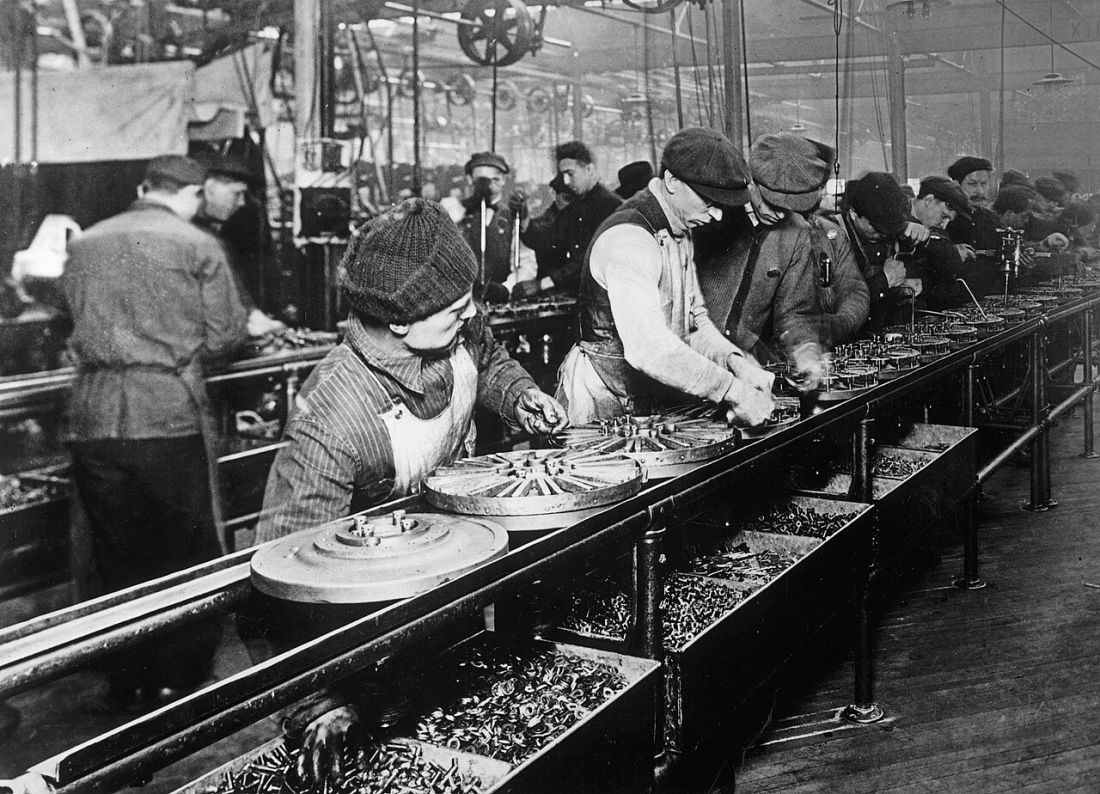
Photo: Ford assembly line (Public domain, via Wikimedia Commons).
Here’s where it gets complicated in a real-life way. The moving assembly line made cars cheaper, but it also made factory work more repetitive. Doing one small task all day can be tiring in a different way than doing lots of tasks. Ford had a serious worker turnover problem in those early years, and one response was the famous “five-dollar day.” On January 5, 1914, Ford announced a minimum wage of $5 per day for an eight-hour day, which was a big jump from the previous rate and hours. The Henry Ford museum’s material describes it as profit-sharing and links it to a 40-hour work week in that era’s framing. Now, this wasn’t just Ford being generous for the sake of it. There was strategy. Higher pay could keep workers from quitting, bring in better applicants, and reduce mistakes from exhaustion. And yes, it also meant workers could become customers, because if you pay people more, they can buy the stuff they’re making. That idea-workers as customers-ends up shaping loads of modern business thinking. It also pushed other companies to look at wages, hours, and productivity in a new way. People started arguing about what a fair wage looks like, what a reasonable workday is, and whether speed should beat safety or comfort. You can draw a line from that to modern conversations about shifts, overtime, burnout, and work-life balance. It’s funny, because we talk about the past like it’s ancient history, but the basic question is still the same: how do you make something affordable without grinding people down? And if you’re sat in Manchester traffic thinking about time, money, and getting where you need to be, you’re living inside the world that mass production helped build. It changed how people earned, how they spent, and what they expected from a job.
Why cars suddenly started shaping cities and everyday life
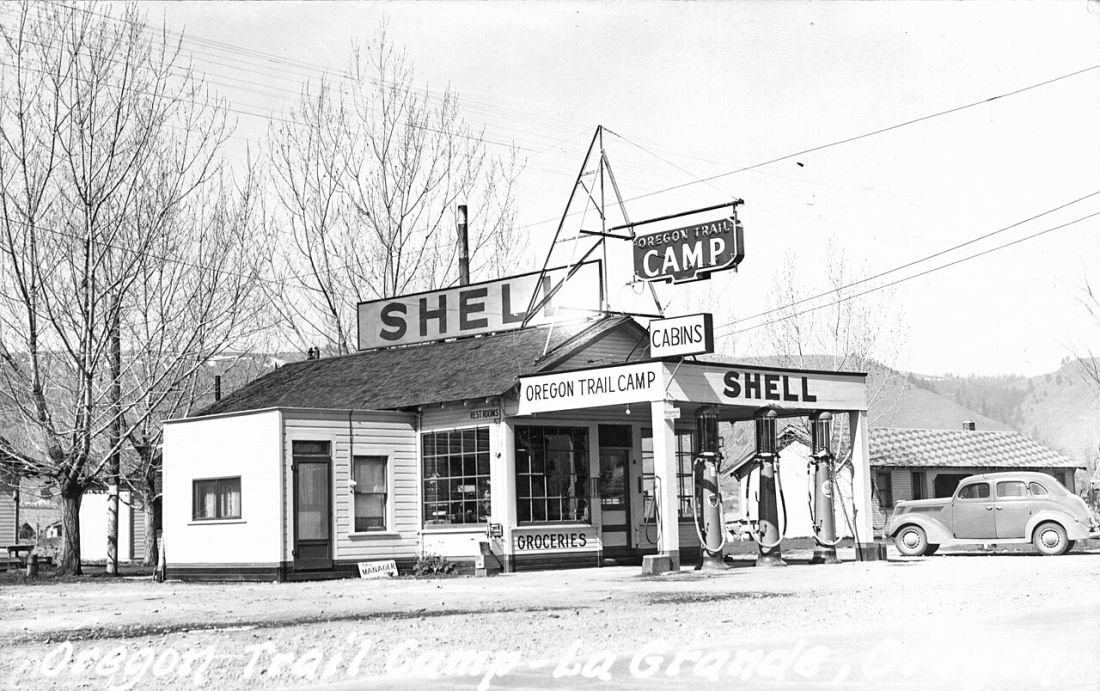
Photo: Petrol station and grocery store in La Grande in 1940 by OSU Special Collections & Archives, Wikimedia Commons.
Once cars became cheaper and more common, everything around them started shifting. Roads needed improving. Petrol stations popped up. Repair shops became a normal thing. Parts supply became a whole industry by itself. And people started living differently because they could travel differently. You didn’t have to live right next to where you worked. Families could visit relatives without making it a full-day plan. Day trips became realistic. That might sound normal now, but it was a big change. And in places like Greater Manchester, where you’ve got a mix of older streets, newer roads, rail lines, canals, and big commuter flows, cars became part of how the area breathes. Think about heading from Stockport up towards Manchester, passing the big rail arches and the tangle of routes that feed into the city. Or getting across to Eccles and seeing how the road network and the shopping areas sit together. Cars didn’t create cities from scratch, but they pushed cities to spread out, and they changed what counted as “nearby.” This is where the assembly line’s impact gets sneaky. You’re not just looking at a factory method anymore. You’re looking at a force that nudged housing, shopping, holidays, dating, school runs, sports travel, and everything in between. It even changed what teenagers dreamed about. Instead of dreaming about a horse or a train ticket, people dreamed about owning a car. And because cars were built in larger numbers with standard parts, repairs and servicing became more predictable. That matters. A car that can be fixed without custom-making a part is a car you can keep running for longer. That’s a big reason the used car market became what it is. If every vehicle was unique, used cars would be a nightmare. But with standardisation and mass production ideas spreading across the industry, used cars became a sensible option, not a risky gamble. That’s part of why places like Stockport can support big showrooms full of choice today. The assembly line didn’t just help Ford sell new cars; it helped make the whole idea of used cars work at scale.
It didn’t stop at cars: factories everywhere copied the idea
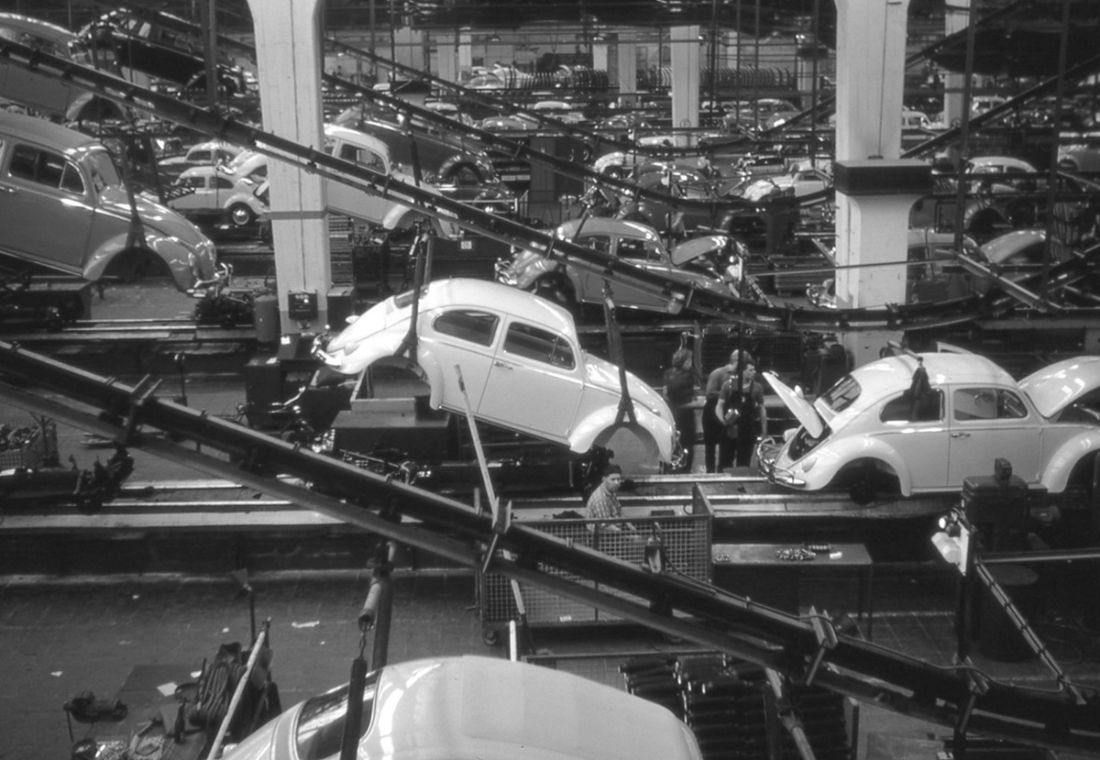
Photo: 1960 Volkswagen Assembly Line in Wolfsburg by Roger Wollstadt, CC BY-SA 2.0, via Wikimedia Commons
Once Ford proved you could take a complex product and build it fast by organising work into steps, other industries jumped on it. Food packing, appliances, radios, furniture, you name it. If something could be broken down into repeatable steps, someone tried building it like that. And it wasn’t a perfect copy. Different products needed different flows. But the mindset spread: plan the work, standardise parts, set up stations, keep things moving, measure time, adjust. This is where you get the bigger cultural ripple that people later called “Fordism” in history and economics writing: mass production linked to mass consumption, plus a new kind of industrial rhythm. You can see it in how supermarkets got bigger, how packaging became more uniform, how people started expecting products to be the same every time. Even the way we think about queues, shifts, timetables, and “efficiency” has some roots in this era. And there’s a slightly weird side effect too: when you’re used to products being consistent, your patience for quirky or inconsistent stuff drops. If your phone charger breaks, you want another one that fits. If a car part fails, you want a matching replacement. That expectation makes life easier, but it also pushes companies to make everything more uniform. You know how it is when you go to a shop and the same thing costs wildly different prices or sizes depending on where you look-people hate that. Mass production trained customers to expect fairness and consistency, even if the real world doesn’t always deliver it. And this spread across borders. European factories learned from American methods, then adapted them. British industry had its own strong manufacturing base already, and places like Manchester had been dealing with huge-scale production since the textile era. So when car manufacturing and modern assembly methods grew, the wider region already had the “make loads of stuff” mindset in its bones. The assembly line idea slotted into that bigger story: Manchester as a place that builds, ships, sells, and moves things, whether it’s cloth in the 1800s or cars in the 1900s and beyond.
The hidden trade-offs: speed, boredom, quality, and control
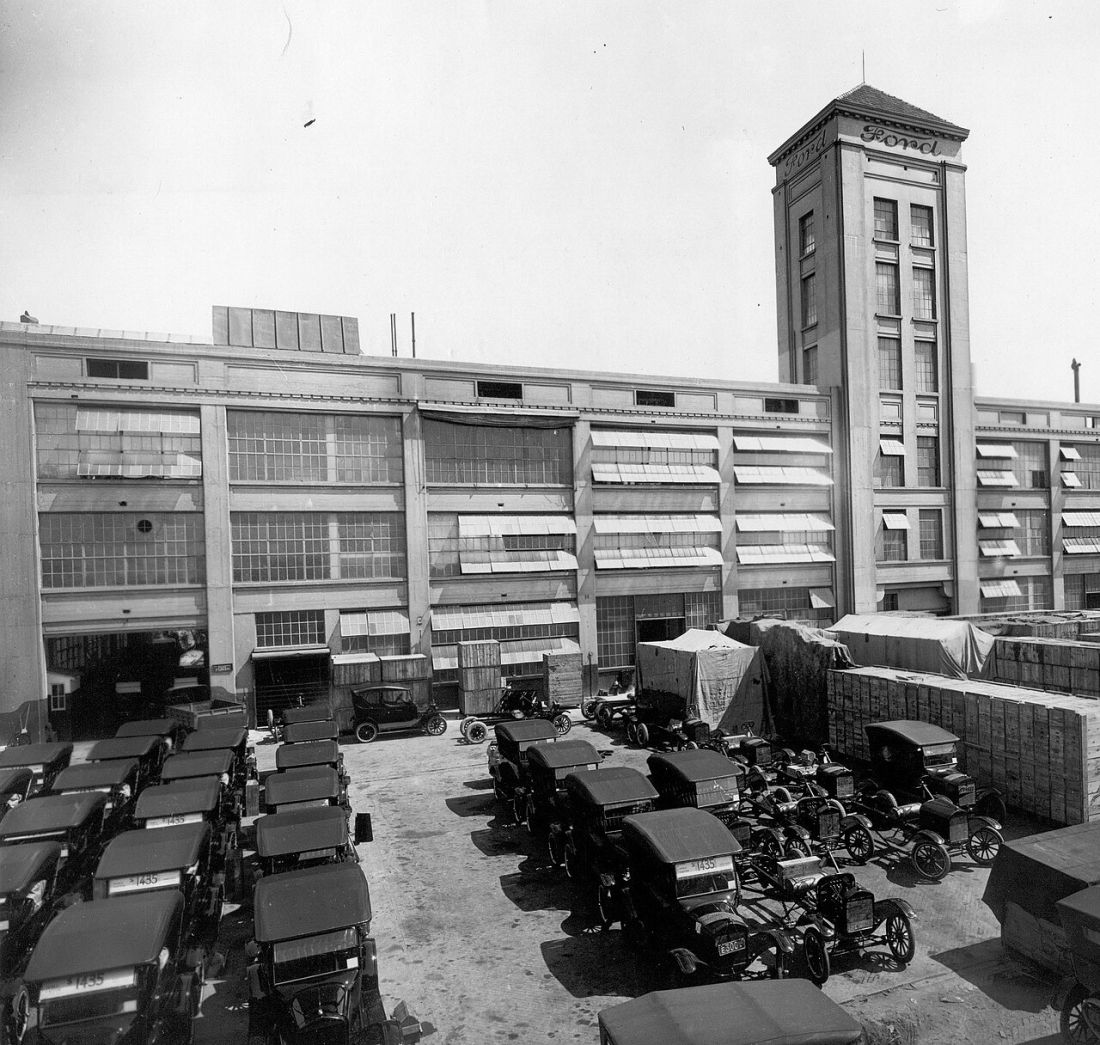
Photo: The Ford Motor assembly plant in La Boca, Buenos Aires by La Nación newspaper, Public domain, via Wikimedia Commons.
Let’s face it, the assembly line wasn’t some perfect miracle with zero downsides. It brought trade-offs, and people argued about them from day one. On the plus side, speed lowered prices and made cars accessible. Standard parts made repairs simpler. The system made planning easier. On the flip side, the work could feel like being stuck in a loop. Repeating the same motion all day can mess with your head and your body. That’s part of why Ford had to think hard about wages and hours. There’s also the question of control. A moving line sets the pace, not the worker. If the line moves, you move. If the line stops, everyone stops. That can create pressure, and it can make workplaces feel strict. Another trade-off is quality. People sometimes assume “faster” means “worse,” but that’s not automatically true. With a good process, repeating the same job can actually reduce mistakes because the worker gets really good at it and the steps become predictable.
But when the pace is pushed too hard, mistakes creep in. So manufacturers had to learn quality checks, better tools, better training, and better layouts. It’s a constant balancing act. And you can see echoes of that in car buying today. Buyers want value, but they also want trust: good history, no hidden surprises, clear checks. That’s why things like vehicle history checks became a big deal in the used car world, because mass production created a massive flow of cars through many hands. If millions of similar cars exist, you need systems to track what happened to each one. It’s also why warranties and aftercare matter to people. When something is common, repairs are easier, but life still throws surprises. So the assembly line didn’t “solve” everything. It shifted the problems. It moved the focus from “can we even build this thing?” to “can we build it reliably, pay people fairly, keep quality high, and still keep prices sensible?” Those are modern questions, just with different tools and nicer coffee.
Bringing it back home: why this still matters in Manchester and Stockport
So why are we, Dace Motor Company, chatting about a factory in Michigan from over a century ago? Because the ripple is still rolling through your daily life in Manchester and Stockport. The used car market exists at scale because cars became common enough, standard enough, and repairable enough for people to own them, sell them, and buy another one without it being a massive gamble. The “choice” you see across different makes-from Alfa Romeo to Volkswagen to Volvo-sits on top of mass production ideas that spread way beyond Ford. And the whole idea of comparing value, comparing features, checking history, checking condition, and sorting finance options is part of what happens when cars move from rare luxury to everyday tool. You can even connect it to how people shop for cars now. You want quick answers. You want clear numbers. You want to know where you stand before you commit. That’s why things like a soft search for car finance (the kind that doesn’t leave a hard mark straight away) feel so normal now: it’s a modern version of the same urge that powered the assembly line-make the process smoother, remove nasty surprises, keep things moving. And on a local level, cars shape how we use the region. Whether you’re heading into Manchester for a gig, popping over to the Trafford Centre area, nipping down the A6, or doing the school run through Stockport’s one-way systems, you’re relying on a world that was built for millions of cars, not a few thousand. The assembly line helped kick that door open. It made cars common, then roads filled, then towns adapted. And now, when you’re choosing a used car, you’re really choosing how you fit into that world: your commute, your weekends, your family plans, your budget, your freedom to move around. That’s a lot of weight for one invention. But that’s what the moving assembly line did. It sped up one factory. Then it sped up the whole planet.