


How Car Soundproofing Works (And Why Some Cars Feel ‘Quieter’)
You know that moment when you shut a car door and it goes “thunk” instead of “clang”? That’s not magic. That’s soundproofing doing its job. And if you’ve ever driven down the M60 with the wind battering the side of the car, or crawled through Mancunian Way traffic with buses rumbling past, you’ll know some cars feel calm inside… and some feel like you’re sitting inside a crisp packet. At Dace Motor Company we see it every day because we’ve got loads of different used cars lined up across our sites, from small city runabouts to big family cars and posh 4x4s. Same roads. Same weather. Totally different noise levels.
Here’s the big idea: a car cabin is basically a moving room. Noise tries to get in through the glass, the floor, the doors, the roof, and even through the air gaps you can’t see. Some noise is “air noise” like wind hiss or a lorry whooshing past. Some noise is “shake noise” where the car body vibrates like a drum skin and you hear that vibration as sound. A quiet-feeling car is one that blocks the air noise, calms the shaking, and stops the little squeaks and whistles that make your brain tired after 40 minutes.
And it isn’t one single part that fixes it. It’s a whole bunch of small tricks stacked together. Thicker glass. Softer layers hidden behind trim. Better door seals. Tyres that don’t roar. And in some cars, a clever system that plays “anti-noise” through the speakers to cancel the low rumbles. Let’s break it down in a way that makes sense without turning this into a physics lesson you’d dodge at school.
Why noise gets in: air routes and “shake” routes
Picture two ways sound can mess with you inside a car. First, sound can travel through the air and slip into the cabin. Wind noise is the best example. Air hits the mirrors and the front pillars, swirls around, and you hear a hiss or a whistle near your ear. Second, sound can travel as vibration through the car’s structure. That’s road noise: the tyre hits the road surface, that vibration runs through the suspension and floor, and the metal panels start to “talk”. If you’ve ever tapped a bare metal panel and it rings, that’s the vibe. Some panels, like big door skins and the boot floor, can behave like a giant speaker cone if they aren’t treated. People don’t notice it until they get in a better-insulated car and go, “Wait… why is this one calmer?”
This is why “quieter” isn’t just about having a smaller engine, or even an electric car. Once the engine sound drops, you notice everything else: tyre roar, wind hiss, little rattles, even water splashing in the wheel arches. Tyres and wind start stealing the spotlight. Some car makers plan for that by focusing on sealing gaps and damping panels. Others keep it simpler to save weight and cost, so you get more sound coming through.
There’s also something basic going on: heavier barriers tend to block sound better. Sound engineers call it the “mass rule” idea: make the barrier heavier and it resists sound moving through it, with a rough rule-of-thumb improvement each time you double the weight of a barrier. That doesn’t mean “just make the car heavy”, because nobody wants a car that drinks fuel like it’s on a stag do. So manufacturers mix weight with smart materials: sticky mats that stop panels ringing, soft foams that soak up echoes in empty spaces, and seals that stop air leaks before they turn into whistles. Once you see it like that, quiet cars stop being mysterious. They’re just better at blocking the routes noise uses.
Acoustic glass: the “sandwich” window that chills the cabin out
Let’s talk glass, because it’s a huge part of what you hear. Regular car glass is hard and smooth, which is good for seeing out of it, but not great for noise. Sound waves hit it and make it vibrate, and those vibrations can pass into the cabin as sound. Acoustic glass tackles this with a simple trick: it’s made like a sandwich. Two layers of glass with a clear, slightly soft plastic layer in the middle. When sound hits the glass, that middle layer helps damp the vibration so less of it gets through. It’s the same basic reason a phone screen with layers can feel “dead” when you tap it compared to a single thin sheet.
Some manufacturers fit this kind of laminated acoustic glass in windscreens and sometimes in side windows. AGC Automotive (a big automotive glass supplier) explains it as using an acoustic plastic layer bonded between two pieces of glass, and that it can cut wind noise that becomes really noticeable at higher speeds. That’s exactly the kind of noise you hear on faster stretches like the M56 or the A6 when you’re moving nicely and the engine isn’t shouting anymore.
There are real measured differences too, not just “it feels better”. A Sekisui Chemical release about an acoustic interlayer film for automotive laminated glass talks about improved sound insulation and reports up to a couple of decibels improvement in tests when used in windscreens and side door glass, with stronger effect in higher frequency ranges. And if you’re wondering why this matters, think about the annoying sounds: the sharp hiss, the scratchy “ssss” from wind, the high-pitched road fizz on rough tarmac. Those are the ones that make conversation harder, even if the car isn’t “loud” in the obvious way.
If you’re comparing used cars, acoustic glass can be a sneaky advantage. You won’t see it from the driver’s seat. But you might notice the cabin feels less busy, like your ears can relax. One giveaway is that some cars list “acoustic windscreen” or “laminated side glass” in their spec. Another giveaway is how the car sounds when a van passes you on a wet road. In a better-insulated car, it’s more like a soft swoosh. In a basic car, it’s a full-on spray-and-roar soundtrack right beside your head.
Mats and heavy layers: stopping the “drum skin” effect
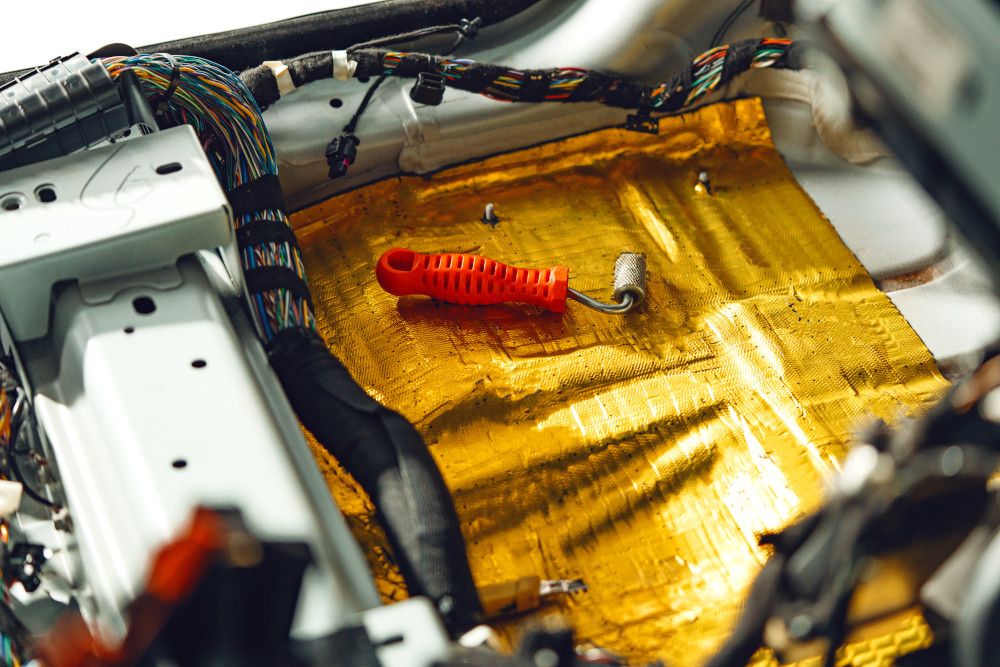
Now to the stuff you don’t see. Under carpets, inside doors, under the boot lining, and on the firewall (the panel between the engine bay and the cabin), manufacturers add mats and barriers to calm vibration and block noise. The first kind is a sticky damping layer. Think of it like putting a finger on a ringing bell. The bell can still move, but it doesn’t ring the same. In cars, big flat metal panels can resonate, and a damping layer reduces that panel vibration so the panel stops acting like a speaker. Sika (a major supplier that works with car makers) explains panel damping products as a way to reduce panel vibration and help with structure-borne sound that affects cabin comfort.
Then there’s the second kind: a heavy barrier layer. This is more about blocking airborne sound, the stuff travelling through the air, by giving it a dense wall to fight through. That’s where the “mass rule” thinking shows up again. ScienceDirect’s engineering overview of the mass law idea says doubling the mass per area can increase sound reduction by about 6 decibels in that rough mass-law region. You don’t need to memorise the number. Just remember: heavier and denser barriers generally block more noise, as long as they’re fitted well and not full of gaps.
Cars mix these layers because each one does a different job. Damping layers help stop the car body “singing”. Barriers help block sound waves. And then, between those, there can be soft separator layers so the barrier doesn’t just vibrate with the metal underneath. When it’s done well, you get that solid, calm vibe when you drive over rough patches. When it’s done cheaply, you’ll hear the road texture through the floor like you’re reading it in braille with your ears.
If you’re thinking, “Can I just add aftermarket mats and make any car silent?” You can improve things, sure, but it’s not a cheat code. Fit matters. Coverage matters. And some noise is coming through the tyres and suspension paths, so you can’t block everything with a bit of sticky mat in the boot. Still, even factory sound packages are basically this concept: stop panels ringing, then block what’s left from passing through into the cabin.
Foam: the soft stuff that eats up echo and kills little rattles
Foam sounds boring until you notice what it’s really doing. Inside a car there are loads of hollow spaces: inside doors, inside the roof lining, inside pillars, behind dashboard panels. If you leave those as empty cavities, sound bounces around in there and then leaks out through trim gaps, speaker grilles, and even little wiring holes. Foam helps because it breaks up those reflections and turns some of that sound energy into tiny amounts of heat through friction inside the foam structure. No flames, nothing dramatic. Just a soft “shhh, calm down” effect.
Foam also helps with rattles. Two hard pieces of plastic rubbing together over bumps can make that irritating “tick-tick” sound that drives you mad after ten minutes. A soft layer between them stops that contact. Some guides describe this as using foam or fibre layers as decouplers, meaning they stop two parts from vibrating as one. That’s why a better-built door card feels tighter and quieter when you close it or hit a pothole.
Here’s a Manchester-flavoured example. You’re rolling over the patched-up road surface near the Etihad on a cold day, or crossing those rougher bits you get around industrial estates. In some cars, you’ll hear a chorus of tiny trim noises: a buzz from the dash, a tap from the door pocket, a squeak that comes and goes. In a better-insulated car, a lot of that is just… missing. Foam pads, felt strips, and snug-fitting parts reduce the little noises so your brain isn’t constantly noticing them.
And foam isn’t just inside the cabin panels. Some cars and tyres use foam in really specific ways, like sticking a foam ring inside a tyre to reduce the “boom” from air resonating inside the tyre cavity. Michelin describes a polyurethane foam solution bonded inside the tyre that muffles resonance to reduce cabin noise. Continental’s ContiSilent tech description says something similar: a polyurethane foam layer attached to the inner tyre surface absorbs tyre cavity noise and reduces how much vibration makes its way into the cabin. So yeah, foam can be a serious piece of the quiet-car puzzle, even if it sounds like something you’d stuff in a sofa.
Seals: tiny gaps, big noise (and the science backs that up)
Seals don’t look exciting. They’re just rubber strips around doors and windows. But they might be the most “bang for your buck” part of quietness, because air leaks are noisy. A tiny gap can create a whistle, a hiss, or that low windy roar near your ear that makes you turn the radio up without thinking. If you’ve ever had a window not fully shut and you got that booming wind sound, you’ve felt how sensitive this is.
There’s proper research pointing at door window sealing as a key factor in how wind noise gets into the cabin. A ScienceDirect paper about door stiffness and vibration mentions that wind noise conveyed from side door window sealing has a very significant effect on how people judge overall vehicle quality. Which makes total sense: your ears are right next to the door glass, so any leak is basically shouting beside your head.
Manufacturers fight this in a few ways. They use multiple sealing lips, tighter door frames, and better alignment so the seal compresses evenly. They also work on the shapes around mirrors and the front pillars to reduce turbulent air, because turbulence is noisy. You can see how serious some brands get about it when they talk about verifying seals and mirror areas. A repair industry piece on the 2021 Mercedes S-Class mentions work on sealing details and even checking multi-foam seals around the mirror triangle area. That’s a fancy way of saying “they hunted down wind hiss like it owed them money.”
For you, the used-car buyer, seals show up in a practical way. If a car has tired, flattened door seals, or a door that doesn’t sit quite right, you may get more wind noise. And the annoying bit is that wind noise can make a car feel cheap, even if the engine and suspension are brilliant. So on a test drive, listen around the top of the door and mirror area at 40-60 mph. If you hear a clean whoosh, nice. If you hear a narrow whistle that changes pitch, that’s a clue. Also, after rain around Stockport, seals matter for another reason: they help keep water out, which helps stop damp smells and foggy windows. Quietness and comfort link together more than people think.
Tyres: why the same car can sound totally different after a tyre change
Let’s face it, tyres don’t get enough blame for cabin noise. People talk about engines and exhausts, but once you’re cruising, tyre noise can be the main soundtrack. And tyres make noise in a few ways. One is pattern noise: as the tread blocks hit the road, they squeeze and release air like thousands of tiny pops. Wired described it in a really relatable way, saying those compressed air bubbles release with little pops, happening thousands of times each second, and it builds into a roar right in the range where human speech sits. They also quote Dale Harrigle, Bridgestone’s chief engineer for replacement tyre development, about how aggravating that can be for talking in the car. That’s a real-world reason some cars feel “loud” even when nothing is broken.
Then there’s tyre cavity resonance, which is a fancy way of saying the air inside the tyre can resonate like blowing across the top of a bottle. Researchers have studied tyre air cavity resonances and how tread impacts can excite that air space. You don’t have to picture perfect waves. Just picture a hollow ring of air that can “booom” at certain speeds and road textures.
This is where foam-in-tyre tech comes in. Car and Driver explained acoustically insulated tyres as using a ring of polyurethane foam bonded to the inner liner to quiet that resonant “ping” idea. TyreRack also talks about manufacturers using sound-absorbing foam inside tyres to combat cavity noise, which becomes more noticeable as cars get quieter in other ways. Michelin and Continental describe their own foam approaches too, as we mentioned earlier.
So here’s the takeaway that helps you right away: two cars of the same model can sound different because of tyres. Different brands, different tread designs, different wear patterns, different pressures, even different road surfaces around Greater Manchester. If a used car feels louder than you expected, don’t panic. It might not be “that’s just how the car is.” It could be the rubber. And if you’re test driving, try a smooth bit of road and a rougher bit. If the noise changes massively with surface texture, that points at tyres and wheel-arch soundproofing more than wind or engine noise.
Active noise control: fighting sound with sound (yes, really)
This part sounds like sci-fi, but it’s real and it’s been around as an idea for ages. Active noise control works by creating a sound wave that’s the opposite of the unwanted sound, so the two waves cancel each other out in the space where your ears are. Think of it like two people pushing a swing from opposite sides at the same time with the same force: the swing doesn’t move much. That “opposite wave” concept was described in a 1936 patent by Paul Lueg, which talks about receiving a sound wave, turning it into an electrical signal, and then producing a sound wave with opposite phase to silence the original in the target area. That’s not a modern influencer idea. That’s nearly a century old.
Later, the researcher Harry Olson wrote about an “electronic sound absorber” in 1953, and other reviews point out that work as part of the early development of active control. And then the tech kept improving until you saw it in real products. Bose’s own history page says their prototype noise cancelling headphones flew on the 1986 Voyager around-the-world flight with pilots Dick Rutan and Jeana Yeager.
In cars, active systems are used mainly for low, droning sounds. The deep “rrrr” you get from tyres on certain roads, or the engine boom at steady speed, those are the kinds of noises that are easiest to cancel because their waves are longer and more predictable. An IEEE review by S. J. Elliott explains active noise control as working on destructive interference and being suited to low frequency sound because of those longer wavelengths.
How does it work in practice? A car uses microphones to listen to the cabin noise, then the audio system sends a carefully shaped signal through speakers to reduce that noise in real time. It doesn’t “delete” everything. You’ll still hear sirens, horns, and random sharp sounds. But it can take the edge off the steady background rumble so the cabin feels smoother, like someone turned down the bass you didn’t ask for. And if you’ve driven two similar cars where one feels less tiring after an hour, active noise control can be part of that difference.
How to spot a quieter used car around Stockport and Manchester
So, practical question: if you’re shopping for a used car, how do you tell what’s genuinely quiet and what’s just “quiet on this one road at this one speed”? Here’s how we’d do it ourselves. Start your test drive somewhere normal, not a silent country lane you’ll never use again. In Stockport, that might mean a mix that includes a smoother stretch and a rougher stretch, plus some stop-start. You want to hear the car in the same sort of mess you deal with day to day. Do 30 mph with the radio off. Then 50 mph. Then a steady cruise if you can. Wind noise shows up more as speed rises. Tyre noise shows up more depending on surface. If the car stays calm through all three, that’s a good sign.
Next, listen for “small noises” because they matter. A quiet car isn’t just low volume; it’s low annoyance. Do you hear a single sharp whistle by the mirror? That can be a seal or alignment clue. Do you hear a plastic buzz that appears on bumps and disappears on smooth road? That’s trim contact. Push gently on the door card with your elbow (nothing silly, just a light press) and see if the buzz changes. If it does, that’s trim vibration, not some spooky engine problem. Also, pay attention to how the car feels when you close the doors. A solid, damped door sound can hint at better damping inside the door structure, though it’s not a perfect test.
If you’re choosing between two cars you love, tyres can be the tie-breaker. Look at brand and tread wear, because a worn or noisy tread pattern will change the cabin sound a lot. And remember, a quiet cabin is not just “luxury vibes”. It can make long drives feel shorter, help you hear kids chatting in the back, and stop you arriving home with that weird tired-head feeling.
If you’re viewing cars with us at Dace Motor Company, you can do this kind of listening on a proper drive around the local roads near our Stockport sites or over near Eccles, not just a quick loop that tells you nothing. And if you find a car that feels calm inside, that’s not luck. It’s all these little soundproofing tricks working together, quietly, in the background. No fuss. Just a nicer place to be.